

Article: Tdns-z 934
Covered bulk freight wagons with controlled gravity unloading and two wheelsets.These wagons are suitable for transporting bulk goods that need to be protected from the weather. They are equipped with a trackside discharge device that allows for controlled unloading of the freight. Most vehicles have an interior coating, which is characterised in particular by protection against contamination, more favourable unloading behaviour (slippage) for goods that flow with difficulty and improved corrosion protection for aggressive cargo. Priority cargoes are fertiliser, lime and coke.
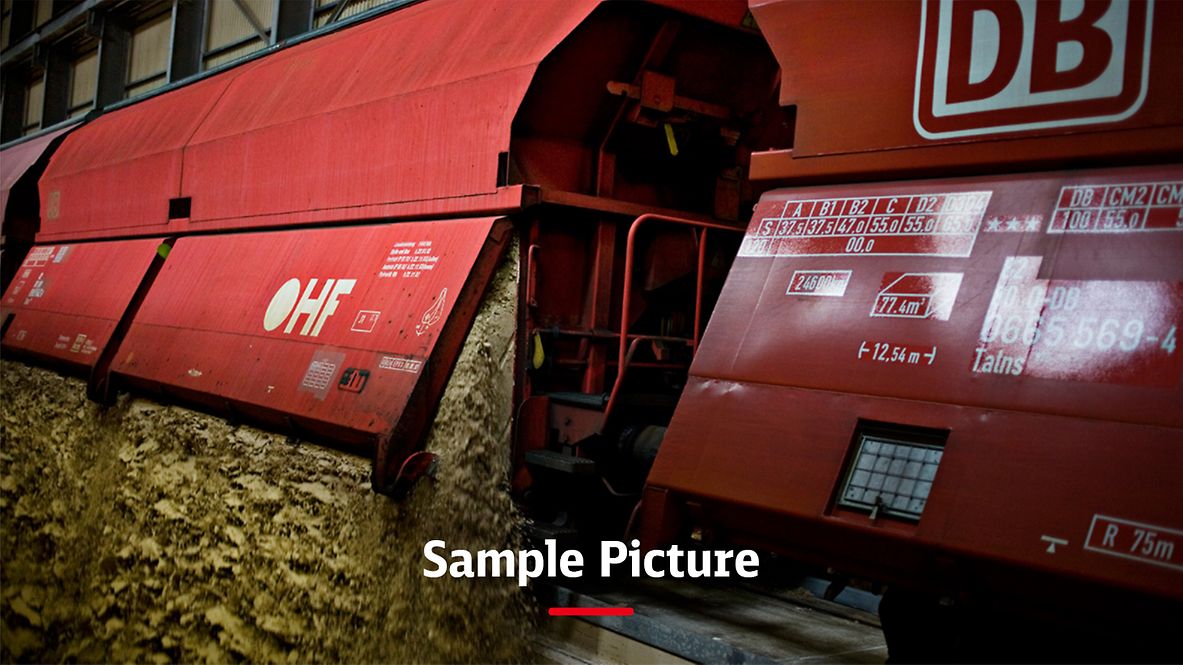
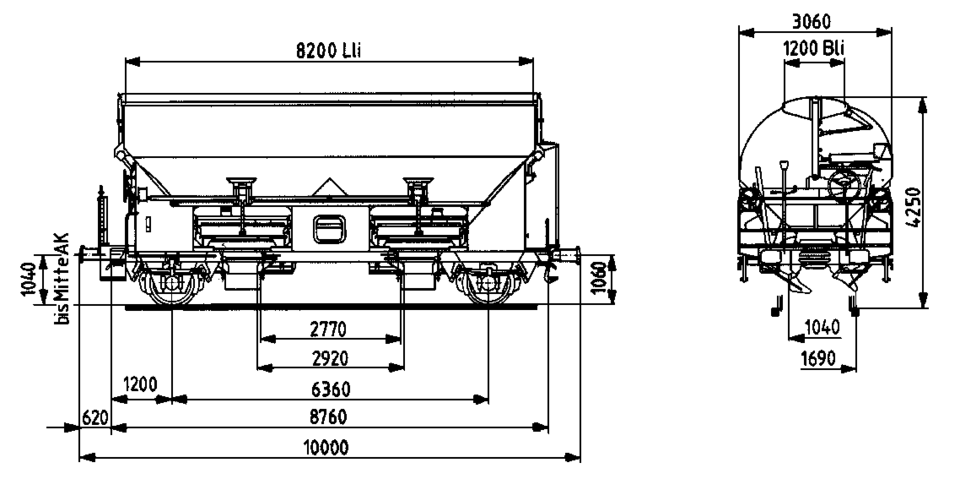
Please note: Type is similar to the wagon in the photo. For exact dimensions, please refer to the drawing and the data below.
Technical details
Loading space (m3) | 42.0 |
Inside width of hopper (mm) | 1,200 |
Inside length of hopper (mm) | 8,200 |
Average tare weight (kg) | 13,500 |
Maximum speed (km/h) | 120 |
International usability | RIV |
Smallest radius of curvature (m) | 35 |
First year of delivery or year of construction of the oldest wagons at this time | 1988 |
Parking brake | With parking brake |
Brake type | KE-GP |
Number of brake cylinders (pcs.) | 1 |
Brake cylinder diameter (mm) | 300 |
Type of load-proportional braking | Two-stage, mechanical, to be changed over manually |
Buffer type: end force (kN) | 590 |
Buffer type: stroke (mm) | 105 |
Buffer head dimensions (mm) | 450 x 340 |
Automatic coupler | Prepared |
Distributor valve type | KE 2adSL-D |
Individual data
Type of spring suspension | Double link |
Width of the fixed discharge chutes (mm) | 600 |
Width of the swivelling additional chutes (mm) | 750 |
Parabolic springs: stretched length (mm) | 1,200 |
Parabolic springs: number of spring leaves | 4 + 1 |
Parabolic springs: spring leaf width (mm) | 120 |
Parabolic springs: spring height (mm) | 202 |
Running gear as per drawing | 1Fwg091.1.02.000.001 |
Load limits
Average tare weight 13.5 t
With parking brake
A | B | C | D | |
|---|---|---|---|---|
S | 18.5 t | 22.5 t | 26.5 t | 31.5 t |
Additional information:
The wagon is covered with a movable roof and has a thick interior coat of PUR paint. It is suitable for transporting all kinds of moisture-sensitive and non-corrosive bulk goods with a grain size < 0.1 mm. The transport of coarse-grained or angular, heavy goods (e.g. gravel, slag, ballast) is not permitted due to possible damage to the inner coating.The controllable discharge rate enables unloading onto conveyor belts. The swivelling discharge chutes allow the wagon to be used for unloading into underground bunkers located directly next to the track. In accordance with the higher axle load of 22.5 t, the load volume has also been increased to 42 m2 to better utilise the load limit even for cargo with a low apparent density.The underframe is welded from rolled steel and folded sections. St 52-3 steel has been used for the underframe, the body support plates and outer body stiffeners. The body of some wagons or all sheet metal that comes into contact with the cargo is made of chromium steel 1.4003. The roof, except for the roof stem, the rotary valves and the outlets with the movable chute extensions are also made of stainless steel 1.4301.Rotary valves are positioned in each side wall. The valves are opened and closed steplessly from the platform with a hand wheel. During unloading, the hand wheel does not need to be locked in any particular way, as the operating system is self-locking and stays in every position.The lower edges of the fixed discharge chutes are 670 mm above top of rail when the wagon is empty; the lower edges of the movable discharge chutes are 390 mm above top of rail when swung out and the wagon is empty.For loading, the lateral sliding roof is opened from the platform with a hand wheel. This exposes an opening of 1,200 mm width extending over the entire length of the wagon. The open roof remains within the vehicle gauge so that shifting movements are possible even when the lateral sliding roof is open.Cargo residues may only be removed from the loading or unloading lane by lightlyknocking on the outer container walls with a rubber hammer or byusing air blow lances in the loading space!For the operation of the wagons, DV 975/2 must be observed.
 Go
Go