

Article: Rilns 654
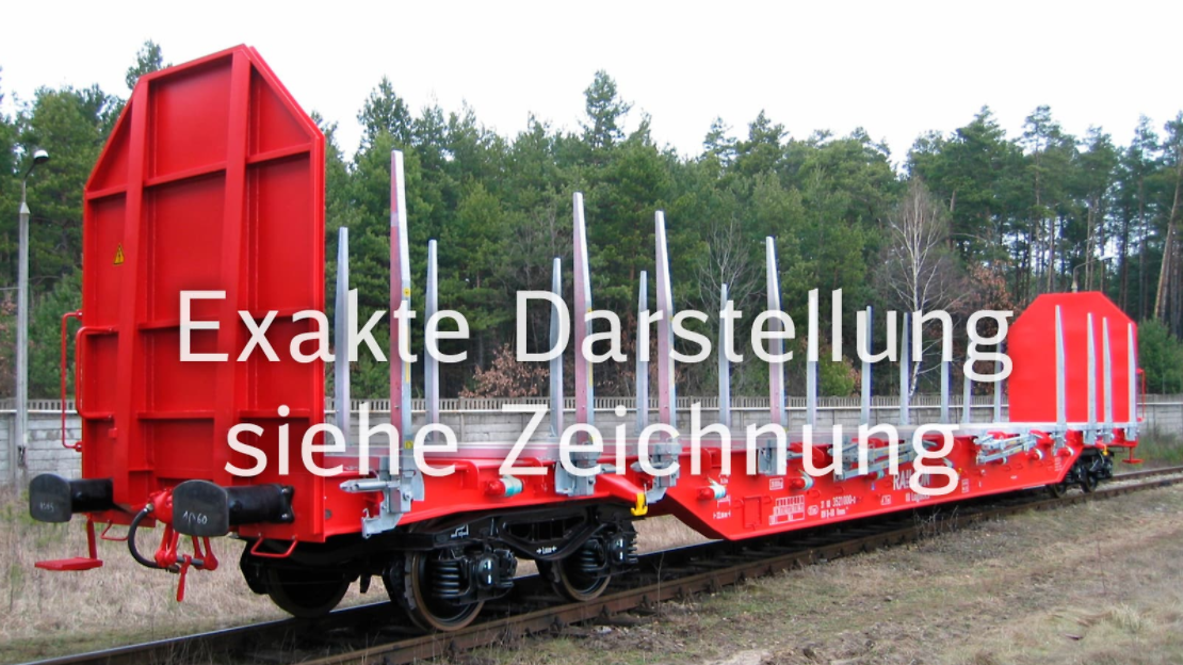
Bogie flat wagon with four wheelsets, with sliding tarpaulin cover, but without stanchions.
The (quick-fit) tarpaulin cover means the wagon can be used to transport goods that must be kept dry. The cover is characterised by simple handling requiring one-man operation, easy movement and central locking. When the cover is open, the loading area is almost completely exposed.
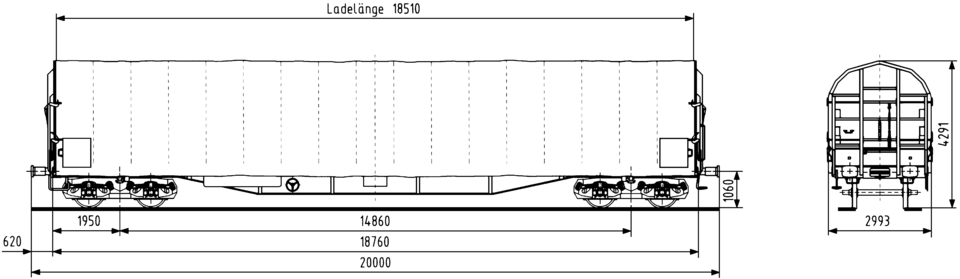
Please note: Type is similar to the wagon in the photo. For exact dimensions, please refer to the drawing and the data below.
Technical details
Loading length (mm) | 18,510 |
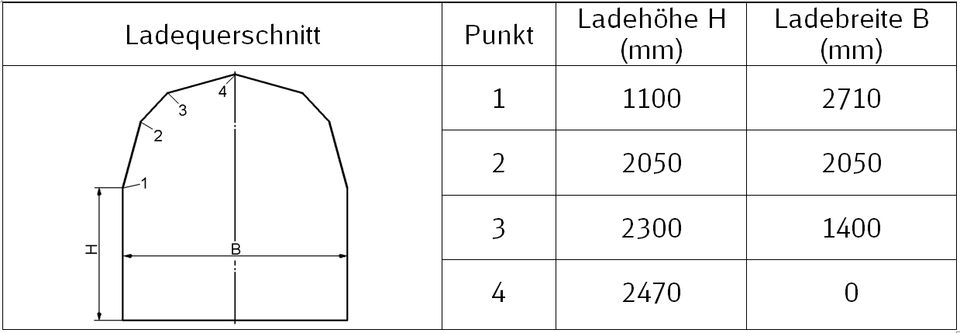
Loading width (mm) | 2,710 |
Loading area (m2) | 49.2 |
Loading space (m3) | Approx. 107.0 |
Average tare weight (kg) | 25,300 |
Maximum speed (km/h) | 120 |
International usability | RIV |
Smallest radius of curvature (m) | 35 |
First year of delivery or year of construction of the oldest wagons at this time | 1994 |
Parking brake | With and without parking brake |
Brake type | KE-GP-A |
Number of brake cylinders (pcs.) | 1 |
Brake cylinder diameter (mm) | 406 |
Type of load-proportional braking | Stepless, independent, pneumatic |
Buffer type | UIC 526-1, Category A |
Buffer head dimensions (mm) | 450 x 340 |
Automatic coupler | Prepared (crossbeam and sliding cradle suspension) |
Distributor valve type | KE 2dSL-ALB/d8 |
Load limits
Average tare weight 25.3 t With and without parking brake
Concentrated loads
|
|---|
Additional information:
The wagon can be used to transport goods that must be kept dry. On each longitudinal side of the wagon, 15 lashing rings are attached to the outer floor edge bar and four lashing rings are attached to the inner sides of each end wall at a height above the floor level of 0.75 m and 1.5 m, respectively. The lashing rings in the end wall withstand a tensile force of 30 kN exerted parallel to the longitudinal axis of the wagon. Furthermore, there are nine retractable lashing devices in the floor on each long side. They are designed for a tensile force of 170 kN at a force application angle of 45° to the floor surface and 30° to the longitudinal centre line of the wagon. The edge bars fitted to the outer solebar are approx. 20 mm higher than the floor of the wagon and thus prevent the load from moving sideways. Each edge bar has 13 integrated fastening points (60 mm wide, round iron 20 mm in diameter).
The tarpaulin roof is locked manually in the closed position. The four-point central locking system on the bulkhead is robust and simple. Due to the selected arrangement of the actuating device, the tarpaulin roof can be unlocked both from the ground and from a ramp. The locking hooks arranged on both sides of each end wall, including their operating levers, are connected to each other by a shaft mounted on a swivel bearing. This allows operation from only one side of the wagon.
The tarpaulin roof can be pushed together towards one end of the wagon so that approximately two-thirds of the wagon is exposed. The wagon may only be operated with the tarpaulin roof closed and locked.
The wagon is covered with a PVC-coated fabric tarpaulin, which rests on 18 tubular frames and is moved in the longitudinal direction of the wagon by means of carriages. The lower carriage rollers act as lift-off protection devices. They grip under the bottom edges of the sliding tracks to prevent the hoods from lifting off in the event of buffing impacts or lateral wind loads.
The end walls are composed of two outer and two middle end pillars and a frame to hold the rubber seal. The metal panels are made of 3 mm plates.
All data provided without any guarantee of correctness or completeness.
 Go
Go